
TECHNOLOGY INTROCUCTION
TECHNOLOGY
INTROCUCTION
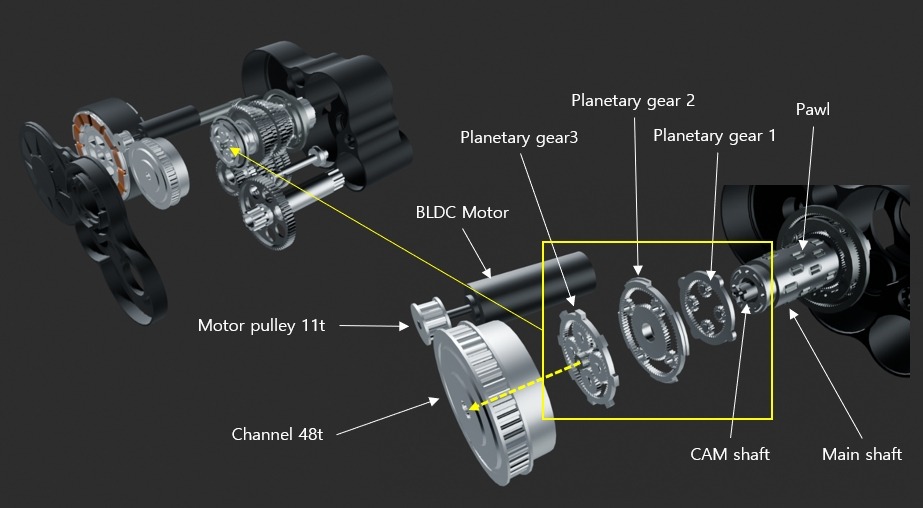
Integrated Drive Channel System: Structure of the Reduction Channel
Reduction Channel
Gearbox shifting begins with the rider’s lever input. Conventional systems use a mechanical cable linking the lever to the gearbox.
In contrast, Allto’s Channel Unit combines three planetary gear stages and actuates the channel via a pulley-and-belt drive connected to a compact motor.
Lever input is received electronically as a digital signal, and the motor—guided by integrated sensors—delivers accurate, consistent actuation.
* A compact BLDC motor drives the channel pulley via a belt.
The center of the channel pulley is fixed to the sun gear of Planetary Gear Stage 3.
Each full motor revolution advances the gearbox by one gear position.
* Planetary Gear Stage 3 transmits torque through two paths:
Path 1: Ring gear → Planetary Gear Stage 2 → Planetary Gear Stage 1 → Main shaft
Path 2: Planet gears → CAM shaft
* These two paths drive the main shaft and CAM shaft in opposite directions.
* Counter-rotation of the CAM shaft and main shaft synchronizes pawl timing.
* A 24:1 reduction ratio is achieved as power is transmitted from the motor through the channel and planetary gears to the shafts, enabling fine angular resolution and highly precise shifting.
Integrated Drive Channel System: Structure of the Reduction Channel
Reduction Channel
Gearbox shifting begins with the rider’s lever input. Conventional systems use a mechanical cable linking the lever to the gearbox.
In contrast, Allto’s Channel Unit combines three planetary gear stages and actuates the channel via a pulley-and-belt drive connected to a compact motor.
Lever input is received electronically as a digital signal, and the motor—guided by integrated sensors—delivers accurate, consistent actuation.
* A compact BLDC motor drives the channel pulley via a belt.
The center of the channel pulley is fixed to the sun gear of Planetary Gear Stage 3.
Each full motor revolution advances the gearbox by one gear position.
* Planetary Gear Stage 3 transmits torque through two paths:
Path 1: Ring gear → Planetary Gear Stage 2 → Planetary Gear Stage 1 → Main shaft
Path 2: Planet gears → CAM shaft
* These two paths drive the main shaft and CAM shaft in opposite directions.
* Counter-rotation of the CAM shaft and main shaft synchronizes pawl timing.
* A 24:1 reduction ratio is achieved as power is transmitted from the motor through the channel and planetary gears to the shafts, enabling fine angular resolution and highly precise shifting.
Integrated Drive Channel System: Structure of the Reduction Channel
Reduction Channel
Gearbox shifting begins with the rider’s lever input. Conventional systems use a mechanical cable linking the lever to the gearbox.
In contrast, Allto’s Channel Unit combines three planetary gear stages and actuates the channel via a pulley-and-belt drive connected to a compact motor.
Lever input is received electronically as a digital signal, and the motor—guided by integrated sensors—delivers accurate, consistent actuation.
* A compact BLDC motor drives the channel pulley via a belt.
The center of the channel pulley is fixed to the sun gear of Planetary Gear Stage 3.
Each full motor revolution advances the gearbox by one gear position.
* Planetary Gear Stage 3 transmits torque through two paths:
Path 1: Ring gear → Planetary Gear Stage 2 → Planetary Gear Stage 1 → Main shaft
Path 2: Planet gears → CAM shaft
* These two paths drive the main shaft and CAM shaft in opposite directions.
* Counter-rotation of the CAM shaft and main shaft synchronizes pawl timing.
* A 24:1 reduction ratio is achieved as power is transmitted from the motor through the channel and planetary gears to the shafts, enabling fine angular resolution and highly precise shifting.